



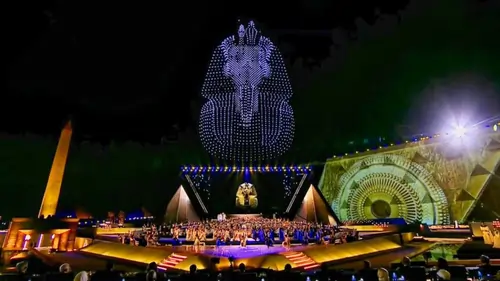

Finally, formally opened Grand Egyptian Museum (GEM), an historic event for Egypt as well as the world. This museum, among the most audacious cultural efforts ever begun, is situated close to the Giza Pyramids. Though the event centered on Egypt's extensive collection of historic artifacts, this opening set itself apart by means of the creative use of artificial intelligence (AI) across the whole museum experience. This perfect combination of contemporary innovation and ancient history shows how Egypt is accepting the future while honoring its own great history.
A Monumental Beginning
Years of Grand Egyptian Museum construction demonstrate Egypt's will to protect its cultural heritage on a worldwide level. Grand official opening ceremony drew global leaders, foreign dignitaries, anthropologists, and media outlets from across the world together. Still, the way artificial intelligence was smoothly incorporated captivated the world beyond the amazing buildings and the sheer magnitude of the things on exhibit. all of the guest experience's parts.
AI Meets Ancient Egypt
One of the most potent drivers of innovation across many sectors, including healthcare, education, art, and entertainment, artificial intelligence has Grand Egyptian Museum has used artificial intelligence to alter the way history is presented and experienced. Visitors go from quiet onlookers to active participants on an interactive tour across time.
Artificial intelligence powered systems greet guests at the entrance and direct them along the museum according on their interests on tailored tours. The artificial intelligence system creates a custom route to let someone enjoy themselves whether they are most interested in Tutankhamun's gold riches, hieroglyphs, or ancient Egyptian medicine. This individual attention guarantees every guest to the museum a unique and unforgettable visit.
Ai Based Interactive Guides
The day of stationary audio guides or printed booklets is passed. Using augmented reality (AR) and natural language processing, Grand Egyptian Museum's artificial intelligence-powered virtual tours lead guests on immersive journeys. These virtual assistants let viewers across to visit the museum by answering questions in several languages.
Visitors can use smartphones or smart glasses to see how initially produced old artifacts seemed. For instance, artificial intelligence can restore the original hues of wall paintings or sculptures decaying over millennia. Visitors can see a magnificent digital overlay of how a thousand-year-old relic once looked—an experience encompassing the A gap between dissimilar ever imaginable, the past and present.
Ai in artifact presentation
Maintaining objects dating over millennia is very challenging. Behind Grand Egyptian Museum, artificial intelligence has a vital behind-the-scenes role. Advanced machine learning methods examine the condition of the artifacts to identify early signs of damage invisible to the human eye. By means of temperature, lighting, and humidity monitoring, artificial intelligence reveals conservators and hence enables them to be proactive to guarantee the long-term preservation of these valuable artifacts.
Moreover, archived every item has been digitized using 3D scanning and artificial intelligence-based image recognition. This means that true digital duplicates will always be saved for next generations even if physical products perish or vanish with time. These virtual archives also enable academics to remotely study Egyptian past with previously unheard-of rigor, hence advancing worldwide academic inquiry.
Ai-Enhanced Research and Education
Beyond a well-known location, the Grand Egyptian Museum is a hub of research and education. Using artificial intelligence-powered solutions that give total knowledge of Egypt's long history enables researchers and students. Using modern texts, inscriptions, and archeological findings, artificial intelligence enables one to find fresh meanings and relationships previously hidden away by time.
One famous instance using natural language processing is translating Egyptian hieroglyphs and other ancient texts. Artificial intelligence algorithms, trained on thousands of inscriptions, may now interpret and decode hieroglyphs much more rapidly than human experts, hence speeding archaeological study. This technological development presents opportunities for worldwide educational cooperation in addition to helping Egyptologists.
immersive AI shows
One of the most significant events at the official opening was the debut of immersive shows driven by artificial intelligence. Guests have access to digital renderings of ancient Egyptian tombs, buildings, and towns. Virtual reality (VR) and artificial intelligence (AI) allowed visitors to revisit real historic occurrences as they played out.
Artificial intelligence in the show is revealed through historical records and creative techniques. The enthronement of Ramses II was recreated on the journey of the Pharaohs. Through actual images and soundscapes, artificial intelligence systems let tourists witness the grandeur of past events. Particularly for younger generations more comfortable with digital interaction, such meetings bring history to life and unforgettable.
AI in security and management
Aside from enhancing the guest experience, artificial intelligence is also essential for assuring the efficacy and security of museum activities. AI-powered security systems track visitor flow and detect any odd activity without invading privacy using facial recognition and behavioral analysis. This technology continuously protects the valuable relics as well as the visitors.
Artificial intelligence also helps with crowd control, especially during important events such the museum's official opening. By examining visitor patterns, predictive algorithms increase navigational effectiveness and prevent crowding especially in certain areas. This level of operating intelligence improves the experience, safety, and fluidity of the museum for everyone.
Sustainability Through AI innovation
Further showing how artificial intelligence contributes to sustainability is the Grand Egyptian Museum. Designed to integrate energy-efficient systems driven by AI-driven environmental monitoring, the building's architecture uses sensors to control illumination and temperature depending on real-time data. Thus reducing energy consumption while maintaining suitable artifact preservation parameters.
Artificial intelligence also helps manage electricity and water, hence supporting Egypt's commitment to environmental responsibility and sustainability. The museum is a model of how technology might enhance cultural legacy without compromising environmental ethics.
Cultural Diplomacy and Global innovation
Including artificial intelligence at the Grand Egyptian Museum sends a strong message to the world: Egypt not only is the hub of civilization but also A forward-looking nation using digital transformation. By mixing its historical past with current inventiveness, Egypt positions itself as a global leader in cultural diplomacy and technological adaptation.
Bringing artificial intelligence to the GEM required international cooperation especially. Egypt worked with international tech firms and artificial intelligence research institutions to create cutting-edge visitor engagement, preservation, and curation systems. This partnership mirrors a rising worldwide trend of fusing technology with heritage preservation, therefore benefiting not only Egypt but also the world.
A glimpse into the future
The part of Grand Egyptian Museum will only get bigger as artificial intelligence technology develops. Future plans include implementing AI-generated storytelling experiences wherein guests will be able to engage with virtual simulations of historical characters like Cleopatra or Tutankhamun. These voice synthesis and generative artificial intelligence enabled avatars will engage in educational and amusing dialogues, bring history to life in a personal manner.
Furthermore, the museum intends to use AI-powered predictive analytics to improve visitor planning by suggesting the ideal times to come and even recommending future displays based on visitor interests.
The Legacy of innovation
The official Grand Egyptian Museum opening signals not only years of diligent effort but also the beginning of a fresh chapter in cultural heritage preservation. Egypt has created a living museum that changes, acquires information, and caters to contemporary guests by including artificial intelligence. respecting the historical legacy.
Thanks to artificial intelligence, the museum has evolved into a vibrant, smart environment where past and future collide rather than only an exhibit of relics. Travelers depart with not only memories of historical wealth but also a knowledge of how technology may strengthen our connection to human society.
Conclusion
From the engineering marvels of the pyramids to today's digital intellect. Incorporating advanced artificial intelligence, the formal opening captures a natural synthesis of art, science, and culture. It demonstrates that if used wisely, technology can help us to better grasp history instead of supplanting it.
This great accomplishment shows that the past and the future are not polar opposites but rather allies in development as the world turns to Egypt yet again. Leading Grand Egyptian Museum, artificial intelligence not only preserves history but also transforms the way the planet perceives it.



Write your comment