



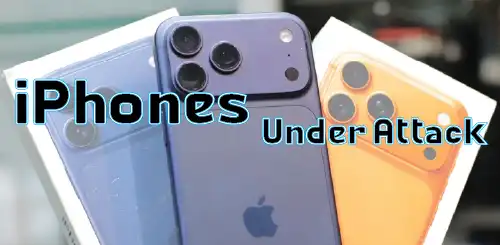

Many people have long seen among the safest consumer electronic goods available the Apple iPhone. Apple's strong belief that iPhones are mostly cyberattack-free has been bolstered by its highly controlled environment, strict App Store rules, and regular security updates. Though this angle has some veracity, it has also caused a hazardous mistake: iPads hacking-proof.
Increasing numbers of cybercriminals seek iOS devices. Attackers view iPhones as ideal targets since they control the high-end smartphone industry and hold enormous volumes of sensitive personal and financial information. From elaborate zero-day attacks to phishing schemes and spyware campaigns, iPhone attacks are getting more sophisticated and widespread.
The way iPhone attacks work, why attackers are after iOS users, and what these threats imply for mobile security's future are all discussed in great depth in this paper.
Why hackers find attractive targets in iPhones
Given its global recognition, the iPhone is an easy target. For identity verification, financial services, work, healthcare, and communication, millions of people rely on iPhones. Access via a single device might reveal passwords, emails, images, messages, and even geographical information.
Trust is another consideration. Less careful behavior can result from many iPhone users thinking their phones are naturally secure. Through social engineering, attackers take advantage of this trust by persuading consumers to click dangerous links or install hostile profiles under the belief that "this wouldn't occur on an iPhone."
Journalists, executives, politicians, and activists also use iPhones extensively. For sophisticated threat actors like nation-state groups, compromising an iPhone may provide intelligence many more useful than attacking a typical gadget.
Common types of Apple iPhone attacks
1. Social engineering and phishing
Still the most often used route for iPhones to get compromised is phishing. Attacks distribute communications using email, SMS (smishing), or messaging applications that appear to originate from Apple, financial institutions, delivery services, or even contacts in the target's address book.
These messages sometimes feature:
• Fake iCloud login warnings
• Notifications of suspicious payments
• Lock warning on account
• Problems with package delivery
Clicking the link transports readers to a bogus website designed to steal Apple ID data. Once an Apple ID is obtained by attackers, they can track the device, permanently lock the user out, or back up data.
2. Configuration and malicious profiles exploits
Configuration profiles, typically used by companies or developers, may be installed on iOS. This feature is abused by cybercriminals who persuade consumers to set up harmful profiles giving attackers elevated permissions.
These profiles can once install:
• Monitor network traffic
• Redirect web activity
• Install unauthorized apps
• Bypass some security barriers
Many consumers are unaware of the risk until their device starts behaving unusually since profiles are a legitimate capability.
3. Spyware and monitoring devices
Spyware is one of the scariest iPhone assaults. Rather of massive efforts, these weapons are often used in targeted attacks. Sophisticated monitoring systems might secretly capture calls, messages, photos, microphones, and cameras unbeknownst to the user.
Many times, spyware attacks depend on zero-click vulnerabilities, therefore the target does not have to tap or install anything.The gadget is vulnerable with just a correctly constructed network packet or message.
Though unusual for regular consumers, these attacks show that in some situations Apple's best security measures may be avoided.
4. Zero-day vulnerabilities
Unknown to the software supplier at the time they are used, zero-day vulnerabilities are flaws in security. Attackers may exploit such a vulnerability in iOS to go beyond security measures before Apple has a chance to publish a patch.
These flaws are particularly hazardous since:
• Initially there is no repair.
• Conventional security measures might not pick them up.
• They may be employed in covert, protracted attacks.
Emphasizing how important quick updates are for iPhone users, Apple often publishes emergency updates to deal with zero-day attacks.
5. Misuse of the App Store and Fake Programs
Harmful applications continue to pass Apple's stringent App Store inspection system now and then. First seeming benign, these apps secretly gather information or redirect users to phony websites using games, tools, or photo editing software.
Some apps also employ clever subscription traps to bring clients into expensive recurring costs. Although not commonly considered as hacking, these activities are exploitation against iPhone users.
Effects of iPhone Attacks in the Actual World
Beyond just trouble, iPhone attacks have repercussions. Victims might suffer identity theft, privacy intrusion, professional harm, or financial loss. compromised iPhones have been used to track journalists, threaten activists, and gather confidential political information in prominent cases.
Employee iPhones can serve as entry points into company networks, revealing proprietary emails, paperwork, and internal systems for companies. iPhone security becomes a major corporate issue as more companies implement "bring your own device" policies.
Apple's response to iPhone security issues
For iOS, Apple is somewhat aggressive on the security front. Its product is updated often; security alerts are released; and researchers are recognized through its bug bounty. Even if an attack occurs, characteristics including sandboxing, encryption, Secure Enclave, and the goal of app permissions is to minimize the harm.
In response to advanced threats, Apple has also introduced:
• Lockdown mode for high-risk users
• Improved phishing detection
• More strong privacy labels on applications
• Fast security responses without whole OS updates
Still, Apple's closed system could prove to be a double-edged sword. Apple's capacity to quickly identify and fix issues is critDical for consumers even if it limits malware distribution.
How iPhone Users Can Keep Safe
Though no device is totally attack-proof, users may greatly lower risk by:
• Always update iOS.
• Activate Two-factor authentication for Apple ID
• Avoid clicking links in unsolicited messages.
• Install apps from reliable developers only.
• Regularly go over application permissions.
• Remove unidentified profiles from the system's settings.
• Have powerful, distinctive passwords.
For those at high risk, letting Lockdown Mode offers an additional line of defense against complex attacks.
The iPhones' Future Security
iPhone security will remain a moving target as cyber dangers keep changing. Attackers are getting more tactical, better financed, and more patient. Many iPhone attacks today emphasize stealth and accuracy rather of mass malware campaigns.
Apple is also spending a great deal on privacy and security as important product differentiators. More AI-driven threat detection, better sandboxing, and deeper user awareness of data access should all be among future iOS releases.
The myth of the "unhackable iPhone" is gradually fading. iOS's true power is in the speed with which dangers are spotted, isolated, and reduced, not in total immunity.
At last,
Apple iPhones remain among the most secure gadgets accessible even if cybercriminals may now be in reach. iOS users have to be cautious and knowledgeable of a growing range of risks, from zero-day attacks and spyware to phishing schemes.
Protecting oneself depends on first knowing how iPhone attacks operate. Attacks change, thus Apple as well as its consumers have to be proactive. Security is an ongoing process rather than a one-time operation. In today's digital world, even the most reliable devices need maintenance.



Write your comment